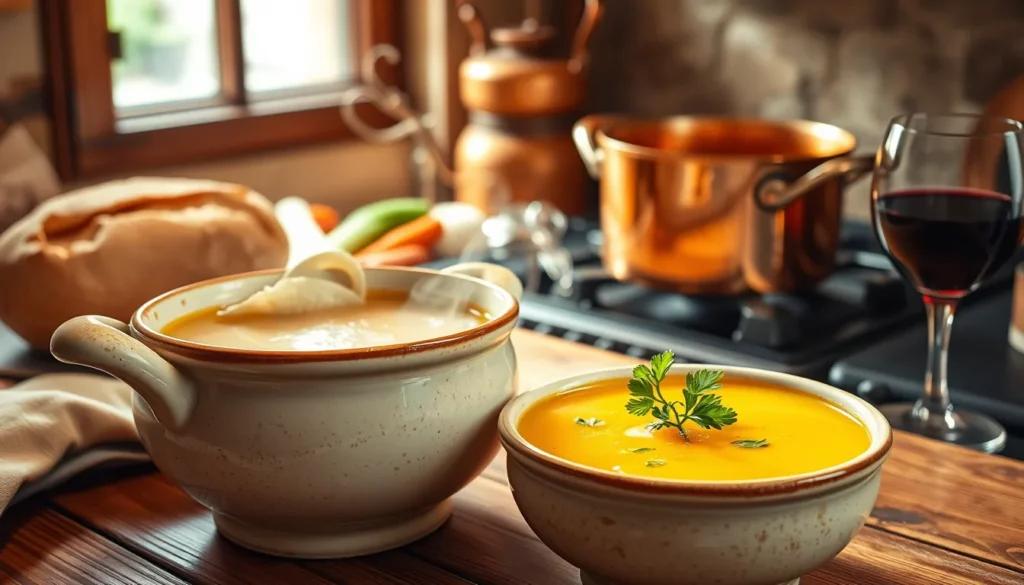
AI-generated illustration for Brodo: The Essence of Italian Broth – History, Variations, and How to Enjoy It
Short Answer
Brodo is the foundational clear broth of Italian cuisine, made by simmering meat, bones, and vegetables. This article explores its ancient origins, regional variations from North to South, and traditional uses as a primo or restorative. Learn what sets authentic brodo apart from stock and consommé.
What Is Brodo? Italian Broth Explained
Brodo (pronounced BROH-doh) is the Italian term for a clear, flavorful broth made by slowly simmering meat, bones, and vegetables in water. Unlike a thick soup or a heavy stew, brodo is a translucent liquid that serves as a foundation for countless Italian dishes or is enjoyed on its own as a comforting first course. Originating in ancient Roman culinary traditions, brodo is a staple across all Italian regions, with key ingredients typically including beef or chicken bones, carrots, celery, onion, and aromatic herbs such as parsley and bay leaf. Its simplicity and depth of flavor make it a cornerstone of Italian home cooking and fine dining alike.
Origin & History
The roots of brodo stretch back to ancient Rome, where a similar preparation called ius (or jus) was used as a base for sauces and soups. The Latin cookbook De Re Coquinaria (attributed to Apicius) contains early recipes for broths made with meat, fish, and vegetables. During the Middle Ages, brodo evolved into a more refined element of Italian cuisine, documented in cookbooks such as Liber de Coquina (13th–14th century). By the Renaissance, brodo had become a symbol of domestic virtue and culinary skill, often served to the sick or as a restorative. The term itself derives from the Germanic word broþ (broth), entering Italian through the Lombardic language. Historically, brodo was not merely a soup but a versatile base for tortellini, passatelli, and risotto, and it remains a fixture in Italian households, especially during holidays and cold months.
What’s In It
Authentic brodo relies on a short list of high-quality ingredients: meat (often beef shank, chicken, or a combination), bones (marrow bones add richness), and a classic soffritto of carrots, celery, and onion. Herbs like parsley, bay leaf, and sometimes thyme or rosemary are added, along with black peppercorns and salt. The preparation is straightforward but requires patience: the ingredients are placed in cold water, brought to a gentle simmer, and cooked for 2–4 hours (or longer for deeper flavor). Skimming impurities from the surface ensures a clear broth. Unlike stock, which is often made with roasted bones for a darker color and stronger flavor, brodo is typically lighter and more delicate. It is also distinct from consommé, which is clarified with egg whites to achieve crystal clarity. Brodo is not a thick soup; it is a transparent liquid that can be served as is or used as a cooking medium.
Regional Variations
Brodo varies significantly across Italy, reflecting local ingredients and traditions. Below is a comparison of three major regional styles:
Region
Key Ingredients
Typical Use
Northern Italy (Emilia-Romagna, Lombardy)
Beef, chicken, veal bones, carrots, celery, onion; often includes a soffritto and a mirepoix.
Primarily used for tortellini in brodo (filled pasta in broth) or as a base for risotto.
Central Italy (Tuscany, Lazio)
Chicken or cappone (capon), sometimes beef; vegetables and herbs; often simmered with a piece of Parmesan rind.
Brodo di cappone is a Christmas tradition, served with passatelli or stracciatella (egg drop soup).
Southern Italy (Campania, Sicily)
Fish and seafood (e.g., scorpionfish, shrimp shells), tomatoes, garlic, parsley; sometimes white wine.
Brodo di pesce is the base for zuppa di pesce (fish soup) or served with crostini.
In addition, brodo vegetale (vegetable broth) is common in all regions, especially for lighter dishes or for those abstaining from meat.
How It’s Traditionally Eaten
Brodo is most often served as a primo (first course) in a traditional Italian meal. It can be presented in a bowl with added elements such as tortellini, passatelli (breadcrumb and cheese dumplings), stracciatella (beaten egg drizzled into the hot broth), or simply with a sprinkle of grated Parmesan and a drizzle of extra-virgin olive oil. In some households, brodo is also consumed as a restorative drink, especially for those feeling unwell, similar to chicken soup in other cultures. It is an everyday comfort food but also appears on holiday tables: brodo di cappone is a Christmas Eve or Christmas Day tradition in central Italy, while tortellini in brodo is a New Year’s Eve staple in Emilia-Romagna. Brodo is rarely served as a secondo (main course) or contorno (side dish); its role is primarily as a warm, nourishing start to a meal.
Common Mistakes / What It’s Not
A frequent misconception, especially in American-Italian contexts, is that brodo is the same as a heavy, opaque soup or that it can be replaced by bouillon cubes or canned broth. Authentic brodo is a clear, delicate liquid that requires fresh ingredients and slow simmering; it is not a thick stew or a cream-based soup. Another error is confusing brodo with stock (brodo is typically lighter and less gelatinous) or consommé (which is clarified to be perfectly transparent). Additionally, some believe that brodo must be made with beef alone, but regional variations include chicken, fish, and even vegetable versions. Finally, brodo is not a dish that should be heavily seasoned or spiced; its beauty lies in the pure, natural flavors of the ingredients.
Where to Try It / What to Order
To experience authentic brodo, travelers should head to Emilia-Romagna, particularly Bologna and Modena, where tortellini in brodo is a signature dish. In Rome, seek out brodo di cappone at traditional trattorias during the Christmas season. For a seafood version, coastal towns in Campania (like Naples) and Sicily offer brodo di pesce as part of a zuppa di pesce. When ordering, ask for brodo as a primo and specify if you want it with pasta or dumplings. In fine dining, some chefs serve a clarified brodo as an amuse-bouche. For home cooks, making brodo from scratch is a rewarding practice; start with a simple chicken brodo and experiment with regional variations.
Brodo is typically lighter and made with meat and bones without roasting, resulting in a clearer, more delicate flavor. Stock often uses roasted bones for a darker color and richer taste, and it has a higher gelatin content due to longer cooking.
Can I use bouillon cubes for brodo?
No, bouillon cubes are highly processed and contain artificial flavors and excessive salt. Authentic brodo relies on fresh ingredients and slow simmering to develop natural depth. Cubes can be used in a pinch but will not replicate the genuine taste.
What is the best meat for brodo?
Beef shank or chuck, chicken (whole or parts), and veal bones are traditional. For a richer flavor, combine beef and chicken. Fish brodo uses non-oily fish like scorpionfish or snapper, along with shells.
Is brodo served hot or cold?
Brodo is almost always served hot, as a warm and comforting soup. It can be chilled and used as a base for cold soups like gazpacho, but that is not traditional.
How long can I store homemade brodo?
Brodo can be refrigerated for up to 4 days or frozen for up to 3 months. Store in airtight containers and reheat gently to preserve flavor.
References
Hazan, Marcella. Essentials of Classic Italian Cooking. Alfred A. Knopf, 1992.
Capatti, Alberto, and Massimo Montanari. Italian Cuisine: A Cultural History. Columbia University Press, 2003.
The Silver Spoon. Phaidon Press, 2005.
Apicius. De Re Coquinaria. Translated by Barbara Flower and Elisabeth Rosenbaum, 1958.
Romer, Elizabeth. The Tuscan Year: Life and Food in an Italian Valley. North Point Press, 1989.
Related Terms
Brodo di carne
Meat-based broth, typically beef or chicken, used as a base for soups and pasta dishes.
Brodo di pesce
Fish broth made from seafood shells and aromatic vegetables, common in coastal regions.
Soffritto
A mixture of finely chopped onion, carrot, and celery sautéed in olive oil, used as a flavor base for brodo and many Italian sauces.
Consommé
A clarified broth, often made from brodo, that is perfectly clear and served as a refined soup.




Leave a Reply