
Short Answer
What It Is
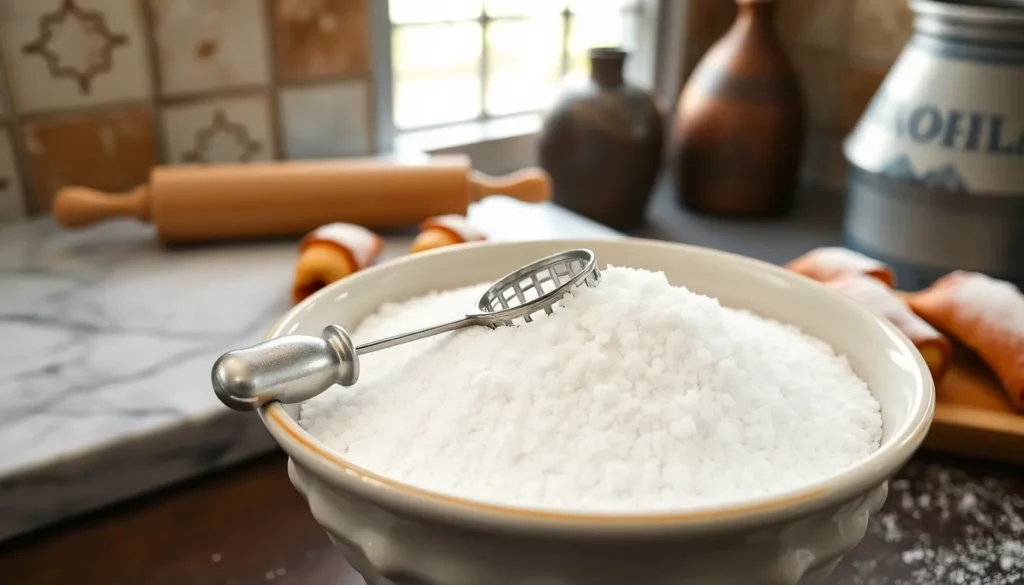
Icing sugar, or zucchero a velo in Italian, is a finely milled sugar typically mixed with a small amount of anti-caking agent (usually cornstarch or wheat starch) to prevent clumping. Its production involves grinding granulated white sugar into a powder with a particle size of about 0.01–0.1 mm, then sifting and blending with 3–5% starch. Unlike coarse granulated sugar, icing sugar dissolves almost instantly, making it ideal for uncooked icings, dusting, and delicate mousses.
While icing sugar is not a DOP or PGI product—since it is a refined commodity rather than a regional specialty—its use in Italian pastry is deeply rooted. Traditional Italian confectionery relies on it for its smooth texture and ability to incorporate air into mixtures without leaving a gritty residue. The term zucchero a velo literally means “sugar like a veil,” reflecting its fine, cloud-like consistency.
Types & Grades
Icing sugar is classified by fineness, measured by the number of times it is ground and sifted. The most common grades in professional Italian kitchens are:

| Grade | Particle Size | Common Uses |
|---|---|---|
| 10X (extra fine) | ~0.01 mm | Royal icing, glazes, dusting |
| 6X (fine) | ~0.06 mm | Buttercream, meringues, pastry creams |
| 4X (standard) | ~0.1 mm | General baking, dusting, simple icings |
In Italy, most commercial icing sugar is 6X or 10X. Some artisanal producers offer organic or unrefined versions (e.g., zucchero di canna a velo from raw cane sugar), but these are less common and may have a slight caramel flavor.
How It’s Used in Cooking
Icing sugar is indispensable in Italian pastry. Its fine texture allows it to blend seamlessly into cold preparations without heating, preserving delicate flavors. Key applications include:
- Tiramisù – The mascarpone cream is often sweetened with icing sugar to avoid graininess.
- Cannoli – The ricotta filling is dusted with icing sugar before serving.
- Panna cotta – A light dusting of icing sugar adds sweetness and visual appeal.
- Zabaione – Icing sugar helps create a smooth, airy foam when whisked with egg yolks and Marsala.
- Dusting – Over zeppole, sfogliatelle, and pizzelle for a snowy finish.
- Royal icing – For decorating panforte and ricciarelli.
“In Italian pastry, icing sugar is not merely a sweetener; it is a textural tool that ensures elegance and precision.” – Gualtiero Marchesi, renowned Italian chef
How to Choose/Identify Authentic Icing Sugar
For professional and home cooks seeking authentic Italian-quality icing sugar, consider these cues:
- Ingredient list – Look for “sugar” and “cornstarch” (or “wheat starch”) only. Avoid added anti-caking agents like tricalcium phosphate if possible.
- Texture – Rub a pinch between fingers; it should feel silky, not gritty. Authentic 10X will dissolve instantly on the tongue.
- Packaging – Italian brands like Eridania or Zefiro are widely available. Check for “prodotto in Italia” on the label.
- Certifications – While no DOP exists, look for organic (Bio) or fair-trade certifications if desired.
- Lump test – Authentic icing sugar should not form hard lumps; if it does, it may have absorbed moisture or contain inferior starch.
Substitutes
In Italian cooking, the best substitute for icing sugar is homemade zucchero a velo: simply grind granulated sugar in a high-speed blender with 1 tablespoon of cornstarch per cup of sugar until fine. Other Italian alternatives include:
- Zucchero semolato – Finer than granulated but coarser than icing sugar; used in some traditional recipes where a slight grain is acceptable (e.g., pastiera napoletana).
- Miele (honey) – For uncooked creams, honey can replace icing sugar, but it alters flavor and moisture content.
- Sciroppo di glucosio – In professional pastry, glucose syrup is sometimes used to adjust sweetness and texture, but it is not a direct substitute for dusting.
When substituting, note that icing sugar contains starch, which affects thickening; adjust liquid ratios accordingly.
Conclusion
Icing sugar is a humble yet vital ingredient in Italian pastry, prized for its fine texture and quick dissolution. While it lacks DOP/PGI status, its role in classics like tiramisù and cannoli is irreplaceable. By understanding its grades, production, and authentic selection criteria, cooks can elevate their Italian desserts with confidence.
FAQ
Can I make icing sugar at home?
Yes. Blend 1 cup of granulated sugar with 1 tablespoon of cornstarch in a high-speed blender or food processor until very fine. Sift before use.
Is icing sugar the same as powdered sugar?
Yes, icing sugar and powdered sugar are the same product. In Italy it is called zucchero a velo.
Why does icing sugar contain cornstarch?
Cornstarch (or wheat starch) is added as an anti-caking agent to prevent clumping and to absorb moisture, ensuring a free-flowing powder.
Leave a Reply