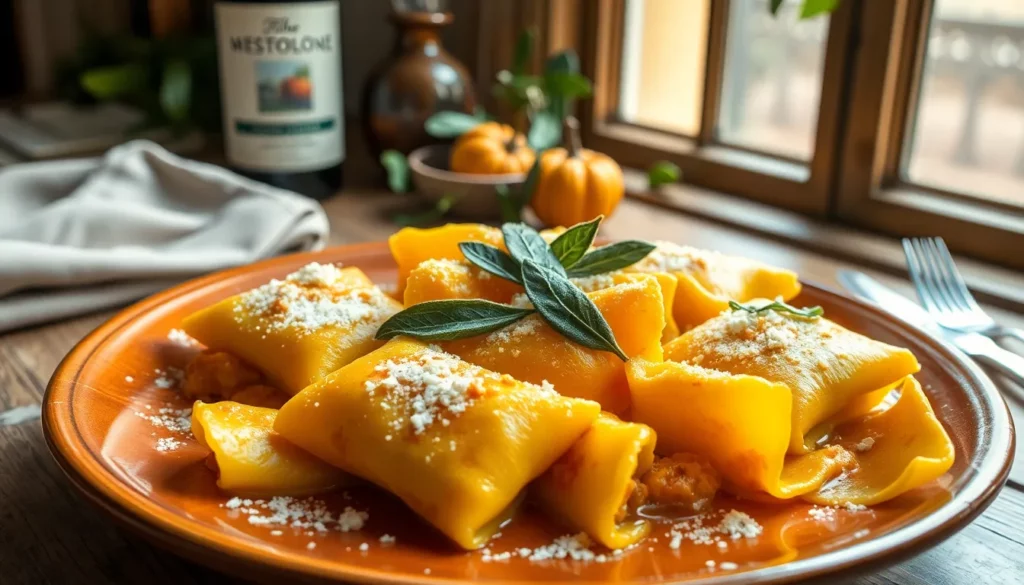
AI-generated illustration for Mestolone: The Stuffed Pasta of Ferrara’s Culinary Heritage
Short Answer
Discover Mestolone, a traditional stuffed pasta from Ferrara, Italy. Learn about its history, ingredients, regional variations, and how to enjoy this rich, festive dish.
What Is Mestolone? Italian Stuffed Pasta Explained
Mestolone is a traditional stuffed pasta from the Emilia-Romagna region of Italy, specifically from the province of Ferrara. It consists of large, rectangular pasta sheets filled with a sweet-savory mixture of pumpkin (zucca), crushed amaretti cookies, grated Parmigiano-Reggiano, nutmeg, and mostarda (candied fruit in mustard syrup). The filled pasta is typically boiled and then dressed with melted butter, sage, and additional Parmigiano-Reggiano. Unlike smaller stuffed pastas like tortellini or ravioli, Mestolone is notable for its generous size—often measuring 5–7 cm per side—and its distinctive autumnal flavor profile. It is a celebratory dish, especially popular during the harvest season and Christmas holidays.
Origin & History
Mestolone hails from Ferrara, a city in the Emilia-Romagna region known for its Renaissance architecture and rich culinary traditions. The dish likely emerged in the 16th or 17th century, when pumpkins were introduced to Europe from the Americas and quickly adopted into Italian cuisine. Ferrara’s fertile Po Valley provided abundant pumpkins, and local cooks combined them with amaretti (a legacy of Jewish-Italian baking traditions) and mostarda (a specialty of Cremona and Mantua) to create a unique filling. Historical records suggest that Mestolone was originally a peasant dish, made with simple ingredients, but it evolved into a festive staple for noble tables during the Este family’s rule. Unlike many myths, there is no single “inventor”; rather, it developed organically in home kitchens and trattorias. Anecdotes tell of farmers using leftover pumpkin and stale cookies to create a hearty meal, which later became a symbol of Ferrarese hospitality.
What’s In It
The core ingredients of Mestolone are:
Pumpkin (usually zucca mantovana or delica): roasted or boiled, then mashed.
Amaretti cookies: crushed, adding almond sweetness and texture.
Mostarda: chopped, providing a sweet-spicy contrast.
Parmigiano-Reggiano: grated, for umami depth.
Egg: to bind the filling.
Nutmeg: a pinch for warmth.
Pasta dough: made from flour and eggs, rolled thin.
Preparation nuances: The pumpkin must be well-drained to avoid a soggy filling. Amaretti are crushed coarsely for texture. Mostarda is finely chopped to distribute evenly. The pasta sheets are cut into rectangles, filled, and sealed with egg wash. Mestolone differs from similar dishes like cappellacci di zucca (which are hat-shaped and often served with butter and sage) in its larger, rectangular shape and the inclusion of mostarda, which gives a distinctive sweet-spicy kick. It also differs from tortelli di zucca (from Mantua) which are semicircular and typically served with melted butter and sage, but without mostarda.
Regional Variations
While Mestolone is firmly rooted in Ferrara, variations exist across Emilia-Romagna and neighboring regions. The table below highlights key differences:
Pumpkin, ricotta, Parmigiano, nutmeg (no mostarda)
Square or round ravioli
Butter and sage or tomato sauce
Romagna (Ravenna area)
Pumpkin, potato, Parmigiano, nutmeg
Oval or half-moon
Ragù or butter and sage
In Ferrara, Mestolone is strictly a holiday dish; in Mantua, tortelli di zucca are eaten year-round. Some modern versions add crushed amaretti to the sauce or use brown butter for extra richness.
How It’s Traditionally Eaten
Mestolone is served as a primo piatto (first course) in a traditional Italian meal. It is typically plated in a shallow bowl, with 3–4 pieces per serving, napped with melted butter and sage, and generously dusted with Parmigiano-Reggiano. The dish is often accompanied by a dry white wine such as a Trebbiano di Romagna or a light Lambrusco. It is a festive dish, reserved for Sunday lunches, Christmas Eve, and harvest celebrations. In Ferrara, it is a highlight of the Sagra della Zucca (Pumpkin Festival) in October. Unlike everyday pasta, Mestolone is labor-intensive and considered a special treat.
Common Mistakes / What It’s Not
Many American-Italian adaptations mistakenly treat Mestolone as a dessert because of the sweet amaretti and mostarda. In reality, it is a savory pasta course. Another common error is using canned pumpkin puree, which is too watery; fresh roasted pumpkin is essential. Some recipes omit mostarda, but that changes the dish’s identity—Mestolone is defined by that sweet-spicy note. It is not a type of ravioli (though similar), nor is it a dessert. It is also not the same as cappellacci di zucca (which are hat-shaped and from the same region but lack mostarda). Finally, Mestolone should never be served with heavy cream or tomato sauce; the traditional butter-sage dressing is non-negotiable.
Where to Try It / What to Order
To experience authentic Mestolone, visit Ferrara during autumn or winter. Top restaurants include:
Osteria del Ghetto (Ferrara) – historic setting, classic recipe.
Trattoria da Noemi (Ferrara) – family-run, seasonal menu.
Al Brindisi (Ferrara) – one of Italy’s oldest wine bars, serves Mestolone during pumpkin season.
For travelers, order “Mestolone di zucca con burro e salvia” and ask if they use mostarda. The best time is October–December. If visiting during the Sagra della Zucca in Ferrara (usually late October), you’ll find Mestolone at food stalls and local festivals. Ordering tip: specify “tradizionale” to ensure the authentic filling.
Mestolone is a traditional stuffed pasta from Ferrara, Italy, made with a filling of pumpkin, amaretti cookies, mostarda, and Parmigiano-Reggiano, served with melted butter and sage.
How is Mestolone different from cappellacci di zucca?
Mestolone is larger and rectangular, while cappellacci are hat-shaped. Mestolone includes mostarda in the filling, giving it a sweet-spicy flavor that cappellacci typically lack.
When is Mestolone traditionally eaten?
Mestolone is a festive dish, commonly served during autumn harvest festivals, Christmas, and special Sunday lunches in Ferrara.
Can I make Mestolone without mostarda?
While possible, omitting mostarda changes the dish's identity. Mostarda is a key ingredient that provides the characteristic sweet-spicy contrast.
What wine pairs well with Mestolone?
A dry white wine like Trebbiano di Romagna or a light Lambrusco complements the rich, sweet-savory flavors of Mestolone.
References
Anderson, Burton. The Foods of Italy: A Culinary Journey. Italian Academy, 2015.
Romer, Elizabeth. The Tuscan Year: Life and Food in an Italian Valley. North Point Press, 1989.
Gosetti della Salda, Anna. Le Ricette Regionali Italiane. Solares, 1967.
Accademia Italiana della Cucina. La Cucina di Ferrara: Storia e Ricette. 2018.
Food and Wine Magazine. 'The Best Pumpkin Pasta in Italy.' October 2020.
Related Terms
Mostarda
A condiment made from candied fruit and mustard syrup, typical of Northern Italy, especially Cremona and Mantua. It adds a sweet-spicy kick to savory dishes.
Amaretti
Italian almond cookies, often crushed and used in fillings or desserts. They provide a distinct almond flavor and texture.
Sagra della Zucca
An annual pumpkin festival held in Ferrara and other Italian towns, celebrating autumn harvest with pumpkin-based dishes, including Mestolone.



Leave a Reply