
Short Answer
What It Is
Confectioner’s sugar, known in Italian as zucchero a velo (literally “sugar on a veil”), is a finely ground sugar that has been milled to a powder and typically mixed with a small amount of an anti-caking agent, such as cornstarch (3–5%), to prevent clumping. The result is an ultra-fine, silky sweetener that dissolves almost instantly, making it indispensable in icings, frostings, dustings, and delicate pastries.
The production of confectioner’s sugar dates back to the 19th century, when mechanical milling techniques allowed for the creation of particles as small as 0.1 mm. In Italy, the tradition of zucchero a velo is deeply tied to the country’s rich pastry culture, though it is not a DOP (Denominazione di Origine Protetta) or PGI (Indicazione Geografica Protetta) product. Instead, it is a standardized industrial product, with quality governed by general food regulations. The finest Italian confectioner’s sugar is often produced by specialized mills in the Po Valley region, where sugar refining has a long history.
“Zucchero a velo come neve” (sugar like snow) – an old Italian saying that captures the ethereal texture of this essential ingredient.
Types & Grades
Confectioner’s sugar is classified by particle size and fineness, typically indicated by an “X” rating. The higher the number before the X, the finer the grind. In Italy, the most common grades are 6X and 10X, with 10X being the standard for professional pastry work. Below is a table of typical grades and their characteristics:
| Grade | Particle Size (microns) | Common Uses | Italian Equivalent |
|---|---|---|---|
| 4X | 150–200 | Dusting, simple syrups | Zucchero a velo grossolano |
| 6X | 100–150 | Glazes, buttercream | Zucchero a velo fine |
| 10X | 50–100 | Royal icing, meringues, dusting | Zucchero a velo extrafine |
| 12X (impalpabile) | < 50 | Professional meringues, delicate decorations | Zucchero impalpabile |
In Italy, the term zucchero impalpabile (literally “impalpable sugar”) is sometimes used for the finest grade, which is so fine it feels like talc. This grade is preferred for high-end pastry work, such as in the preparation of pasta di mandorle (almond paste) or pan di Spagna (sponge cake).
How It’s Used in Cooking
Confectioner’s sugar is a cornerstone of Italian pastry and dessert making. Its ability to dissolve without heat makes it ideal for uncooked preparations. Here are some traditional Italian applications:
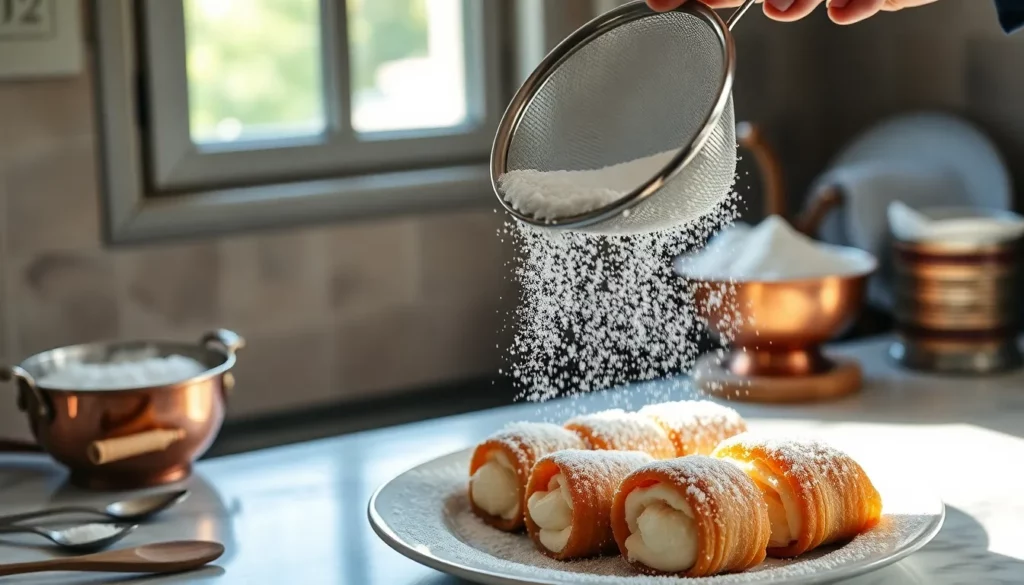
- Dusting: A light snowfall of zucchero a velo over cannoli, zeppole, or panettone adds visual appeal and a touch of sweetness.
- Icings and Glazes: Used in glassa reale (royal icing) for panforte and crostata, and in simple lemon or almond glazes for ciambellone.
- Meringues: Essential for Italian meringue (meringa all’italiana), where the sugar is dissolved in hot syrup, but also for French meringue where powdered sugar is beaten into egg whites for a stable foam.
- Buttercream: In crema al burro, confectioner’s sugar ensures a smooth, lump-free texture.
- Desserts: Key in tiramisù (for the mascarpone cream), panna cotta (as a stabilizer), and semifreddo.
- Pastry Doughs: In shortcrust pastries like pasta frolla, it creates a tender crumb because it absorbs less water than granulated sugar.
Professional Italian pastry chefs often prefer zucchero a velo over granulated sugar in recipes where a fine texture is critical, such as in savoiardi (ladyfingers) or pasta choux.
How to Choose/Identify Authentic Confectioner’s Sugar
For commercial-intent readers, selecting the right confectioner’s sugar is crucial for consistent results. Here are key authenticity cues:
- Check the label: Look for “zucchero a velo” on Italian imports. Authentic Italian brands often list the anti-caking agent as amido di mais (cornstarch) or fecola di patate (potato starch). Avoid products with artificial additives.
- Particle size: For most applications, 10X is the standard. If the sugar feels gritty between your fingers, it is too coarse. Professional kitchens should seek 10X or zucchero impalpabile.
- Packaging: Reputable Italian producers (e.g., Eridania, Zefiro) use sealed, moisture-proof bags. Avoid bulk bins where humidity can cause clumping.
- Certifications: While no DOP exists, look for IFS (International Featured Standards) or BRC (British Retail Consortium) certifications on industrial packages, indicating quality control.
- Visual test: Authentic confectioner’s sugar should be pure white, free of yellowing or specks. A small amount rubbed between fingers should feel silky, not sandy.
For Italian authenticity, the presence of a small amount of cornstarch is a positive sign, as it prevents caking without altering flavor. Some artisanal producers offer organic versions with tapioca starch.
Substitutes
When confectioner’s sugar is unavailable, Italian cooks have several genuine substitutes:
- Homemade zucchero a velo: Grind granulated sugar in a high-speed blender or spice grinder with 1 tablespoon of cornstarch per cup of sugar. Sift to achieve a fine texture. This is the most authentic substitute.
- Zucchero semolato: A very fine granulated sugar (not powdered) can be used in recipes where the sugar will be dissolved, such as in syrups or meringues, but it will not work for dusting or uncooked icings.
- Zucchero impalpabile: If you can find this professional grade, it is the closest substitute, though it may be harder to source.
- Non-Italian alternatives: In a pinch, use standard powdered sugar from any supermarket, but check that it contains an anti-caking agent. Avoid “icing sugar” that may have added flavors or fats.
Note: Substituting with granulated sugar in recipes that rely on the fine texture of confectioner’s sugar (e.g., buttercream, royal icing) will result in a grainy, unstable product.
In conclusion, confectioner’s sugar is a versatile and essential ingredient in Italian pastry, prized for its fine texture and quick dissolution. Whether you are dusting a classic cannolo or crafting a delicate meringa, understanding its grades, uses, and authenticity will elevate your culinary creations. Choose a high-quality 10X or zucchero impalpabile for the best results, and always store it in a cool, dry place to maintain its silky perfection.
FAQ
What is the difference between confectioner's sugar and powdered sugar?
In most contexts, they are the same product: finely ground sugar with an anti-caking agent. In Italy, 'zucchero a velo' is the standard term. The term 'powdered sugar' is more common in the US, while 'icing sugar' is used in the UK. All refer to the same ingredient, though grades may vary.
Can I make confectioner's sugar at home?
Yes. Blend 1 cup of granulated sugar with 1 tablespoon of cornstarch in a high-speed blender or spice grinder until fine. Sift through a fine-mesh sieve to remove any coarse particles. This homemade version works well for most recipes, though it may not be as fine as commercial 10X.
Why does confectioner's sugar contain cornstarch?
Cornstarch (or potato starch) is added as an anti-caking agent to absorb moisture and prevent the sugar from clumping. It is typically present at 3–5% by weight and does not affect the flavor. Some organic brands use tapioca starch instead.

Leave a Reply